Date:
From:
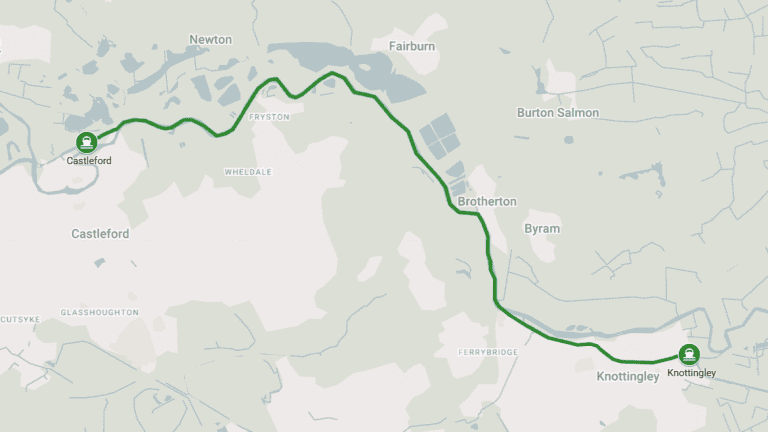
Castleford
To:
Knottingley
Waterway:
Aire & Calder Navigation
and River Aiver
Travel Time:
3 1/2 hours
Distance:
6.5 miles
Contents:
After several days moored in Castleford following Round Tuit’s stay in the dry dock, it was finally time to move on. Our destination for the day wasn’t especially ambitious, but it would take us back onto the River Aire.
The morning began with a practical necessity rather than a picturesque cruise.

Before leaving Castleford, we stopped to fill our water tank. It’s one of those boating jobs that isn’t particularly exciting but is absolutely essential. With the tank full and everything ready for the next leg of the journey, we cast off and headed towards Bulholme Lock.
At first glance, Bulholme is an impressive structure. It features an additional set of gates in the centre, allowing it to accommodate both smaller craft and much longer commercial vessels. It’s a reminder that the Aire & Calder Navigation was built not just for leisure boating but as a major transport route for industry.
As we approached, John eased the boat into the first open section while I headed ashore to prepare the lock.
That’s when things became a little more complicated.

Bulholme Lock is electrically operated, so normally the process is fairly straightforward. Insert the key, follow the sequence and the gates obediently do what they’re supposed to do.
Or at least that’s the theory.
No matter what I tried, the gates refused to open.
Fortunately, there was a volunteer lock keeper on duty. I climbed the stairs to the control tower and explained the problem. He immediately came down to help and together we worked through every possibility we could think of.
Nothing seemed to make any difference.
Eventually we began to suspect that the problem wasn’t with the gates at all but with the sluices at the opposite end of the lock. If they weren’t operating correctly, the system wouldn’t allow the gates to move.
With John joining the effort, we continued troubleshooting until, finally, the lock sprang into life and began behaving as it should.
The relief was immediate.
Once through, the volunteer reported the issue and requested that the maintenance team investigate. Although we’d managed to get everything working, he was understandably concerned that the fault might reoccur.
Moments like this highlight just how valuable the volunteer lock keepers are. Their local knowledge, practical experience and willingness to help keep the waterways moving when things don’t quite go to plan.

With the lock finally behind us, we emerged once again onto the River Aire.
The transition from navigation to river always feels significant. Suddenly the water stretches wider, the banks seem further away and Round Tuit feels a little smaller in her surroundings.
The riverbanks were lush with spring growth. Trees lined the water’s edge, wildflowers brightened the greenery and birds wheeled overhead in the breeze.
It was undeniably beautiful.
Yet we have to admit something that may be slightly controversial among boaters.
As attractive as the rivers are, we often find them a little less engaging than the canals.
On the canals there’s usually something happening. Walkers stop to chat, anglers wave from the bank, cyclists pass by and villages seem to appear around every bend. Rivers can feel more remote. Beautiful, certainly, but often quieter and with fewer encounters along the way.
Of course, that’s part of their appeal for many people.
For us, though, we sometimes miss the bustle of canal life.
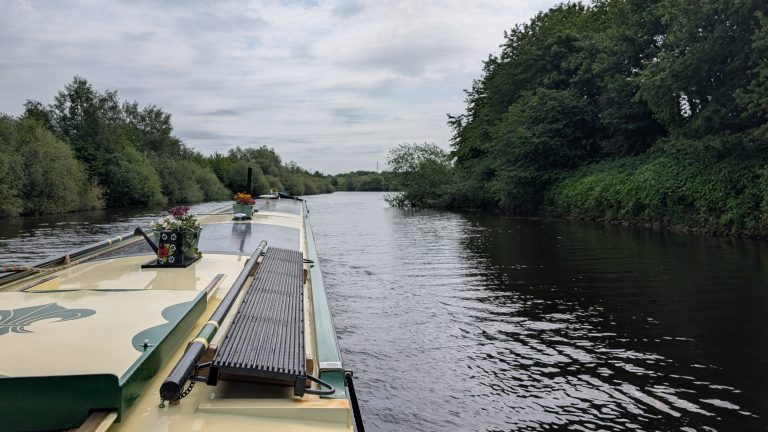
The weather was considerably brighter than it had been on previous days. Sunshine illuminated the riverbanks and sparkled on the water, although a strong wind kept temperatures feeling surprisingly cool.
Gradually we passed beneath railway bridges and roads, following the broad course of the river eastward.
Then the unmistakable sight of Ferrybridge came into view.
The former power station site remains a landmark on this stretch of waterway and signals a change in character. Beyond it, the landscape becomes more developed, with industry, warehouses and housing gradually replacing the rural scenery.
There was suddenly much more to look at.

Approaching Ferrybridge Flood Lock required a little concentration.
Boats need to stay to the right and use the lock landing before operating the lock. Unfortunately, when we arrived it quickly became clear that getting ashore wasn’t going to be straightforward.
The landing sat high above the boat and there was no graceful way for me to climb up from where I was standing.
John came to the rescue.
After securing the boat to a bollard, he climbed onto the roof and helped me do the same. From there I was able to scramble onto the path above.
The manoeuvre worked perfectly.
The only problem was that there seemed to be plenty of people around to witness my rather less-than-elegant ascent.

Like Bulholme, Ferrybridge Flood Lock is electrically operated.
The process itself was familiar enough: opening gates, operating sluices, waiting for permissions and then repeating the sequence at the opposite end.
What felt slightly amusing was the fact that the water level difference was almost non-existent.
As a flood lock, its primary purpose isn’t really to raise and lower boats in the traditional sense. Instead, it helps manage navigation during varying river conditions.
Even so, after all the button pressing and gate operating, it was hard not to feel that the actual locking process had achieved very little.
Still, rules are rules.

Leaving the flood lock brought us back onto the Aire & Calder Navigation.
Almost immediately the character of the waterway changed.
The broad river gave way to a narrower, more canal-like channel. The banks felt closer, the pace felt gentler and, perhaps most importantly, there were people about.
We exchanged greetings with walkers passing along the towpath and instantly felt more at home.
It’s funny how quickly a familiar environment can change the atmosphere of a journey.
After Shepherds Bridge, however, the navigation began to widen once more as we approached an important junction.
Here the route divides.
To the right, the canal continues onward.
To the left, the navigation rejoins the River Aire.
Tomorrow’s route towards Selby lies to the left.

Rather than continue any further, we chose to stop for the night just before the junction.
It’s an interesting mooring.
Directly opposite sit many large vessels, reminders of the commercial heritage that still shapes this waterway. The sounds of industry drift across the water throughout the day, creating a constant background soundtrack.
It’s certainly not the quietest place we’ve ever stayed.
Yet there are compensations.
Around our side of the mooring there’s plenty of open green space, giving Boasley ample room to stretch his legs and explore. As the evening light softened and the day’s traffic faded away, it felt like a good place to pause before tomorrow’s journey.
Ahead lies another stretch of the River Aire and the route towards Selby.
For now, though, Round Tuit rests between canal and river, poised for the next chapter of the adventure.