A Hull Makeover at Castleford

Date:
From:
Woodlesford
To:
Castleford
Waterway:
Aire & Calder Navigation and River Aire
Travel Time:
2.5 hours
Distance:
5.6 miles
Contents:
Cruising to ‘The Boat Yard’ on the Aire & Calder Navigation
There are some journeys that are memorable for the scenery, some for the weather and some because they mark an important milestone in a boat’s life. Our trip from Woodlesford to Castleford combined all three, culminating in Round Tuit’s week-long stay in dry dock for a major hull refurbishment.

Setting Off from Woodlesford
We left Woodlesford on the morning of Tuesday 12th May, beginning with the straightforward task of passing through Woodlesford Lock. As an electrically operated lock, all it required was inserting our key into the control panel and following the instructions. Compared with some locks on the network, it couldn’t have been simpler.
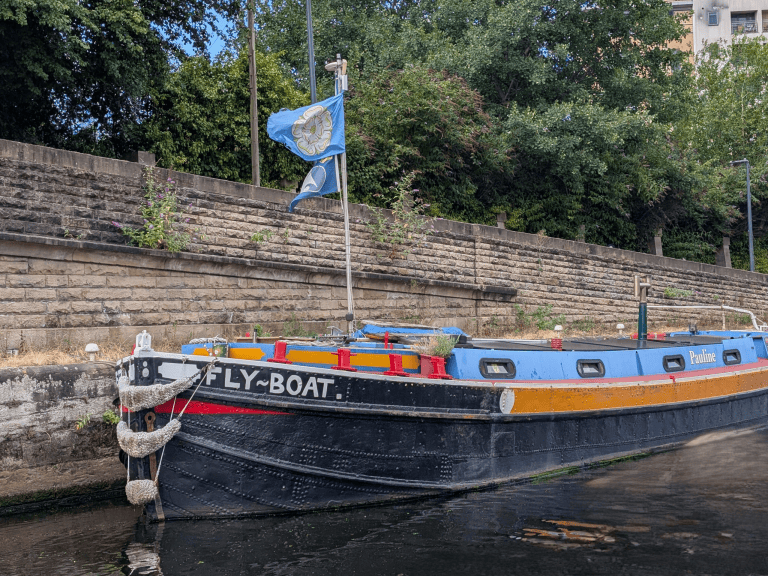
Once through, we settled into a leisurely cruise along the Aire & Calder Navigation. This is a waterway that always feels slightly different from the narrow canals that many boaters are familiar with. The navigation is broad and spacious, with large commercial vessels and workboats often moored along its banks, reminders of its industrial heritage.
Despite the cool, overcast weather, the journey was full of colour. Spring flowers brightened the towpath edges, while ducks paddled quietly through the reeds. The skies threatened rain, so we were dressed accordingly, but for now the weather held.

Coffee at Lemonroyd Marina
Our first stop was Lemonroyd Marina, where we needed to empty the toilet tank before continuing our journey.
It’s a convenient facility for passing boaters, although it is worth contacting the marina beforehand to let the team know you’re coming.
While John operated the suction pump, I took the opportunity to make us both a coffee. We sat together on the stern deck, mugs in hand, watching life in the marina unfold around us.
What struck us most was the variety and size of the boats. Many were considerably larger than those we regularly encounter on the canal system, reflecting the wider dimensions of the Aire & Calder Navigation itself.
By the time we were ready to leave, the wind had strengthened considerably. Turning Round Tuit around within the marina basin became a challenging exercise, but after a little perseverance John managed it successfully and we were soon underway once again.

The Luxury of a Lock Keeper
Our next stop was Lemonroyd Lock.
This impressive lock marks the transition from the Aire & Calder Navigation onto the River Aire and, because of its size and importance, it is operated by a Canal & River Trust lock keeper.
For me, this was something of a luxury.
Normally, lock passages involve plenty of hopping on and off the boat, handling gates and paddles, and generally keeping busy. This time I simply stayed aboard while the lock keeper took care of everything. It’s not often I get to sit back and enjoy the ride through a large lock, so I made the most of it.
As we descended onto the river, the weather finally caught up with us.

A Short Burst of Rain
The clouds darkened almost immediately after leaving the lock, and within moments a heavy shower swept across the river.
For ten minutes the rain hammered down, soaking everything in sight. Fortunately, it passed as quickly as it arrived.
Before long the skies began to brighten again and the breeze helped dry us off, allowing us to continue our journey in relative comfort.

Navigating Through Castleford Junction
Approaching Castleford Junction always requires a little attention.
Ahead lies a substantial weir, and continuing straight towards it would be a serious mistake. Fortunately, the signage is clear and we carefully followed the route to the left, passing through Castleford Flood Lock, which was standing open on our arrival.
The flood lock returned us to the Aire & Calder Navigation, and just beyond it on the right-hand side sat our destination for the weekend: ‘The Boat Yard’.
For now, however, we cruised past.
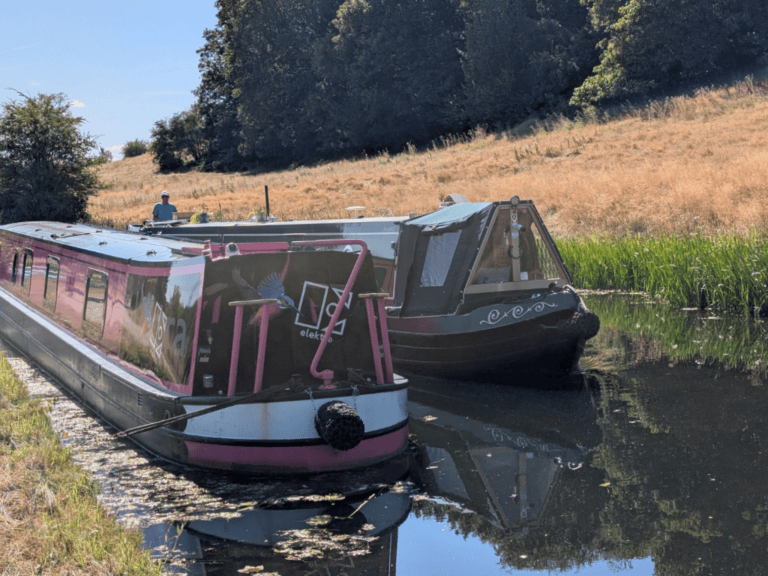
We found a mooring a short distance beyond the yard. While the surroundings had a slightly industrial character, it was a pleasant enough spot with plenty of other boats nearby and it would serve us well while we waited for our dry dock appointment.

Into Dry Dock
Saturday morning arrived and it was finally time.
We turned Round Tuit around and made the short journey back to ‘The Boat Yard’.
Before we untied the ropes, Craig, Gareth and Adam walked down the towpath to meet us and let us know they were ready. The entrance to the dry dock is not especially forgiving, with boats moored close by on either side, but the team guided us every step of the way.
Their calm instructions and reassuring presence made what could have been a stressful manoeuvre feel remarkably straightforward.
Once inside, a second boat entered alongside us before the dock gates were closed behind both vessels.
The team then explained exactly what would happen next, making sure everyone was comfortable with the process.
With preparations complete, a large valve at the head of the dock was opened and the water began draining away surprisingly quickly. As the water level fell, the team carefully monitored both boats, ensuring they settled correctly onto their supports and remained stable throughout.

Seeing the Hull for the First Time
Our booking included shot blasting the hull sides and baseplate, applying a two-pack protective coating and fitting two additional anodes.
Once the dock was empty, John finally had the opportunity to walk around the entire hull and inspect its condition.
The first thing we noticed was just how green it had become. Two years of cruising had allowed plenty of algae and growth to accumulate beneath the waterline.
The good news was that beneath the grime, the hull itself was in excellent condition.
Knowing that the steel remained sound was reassuring, and the work planned by the team

Swallows and Shot Blasting
Although it would have been possible to remain aboard during the work, we decided against it.
Shot blasting is an extremely dirty and noisy process, and it simply wouldn’t have been a pleasant environment for Boasley.
So, with our bags packed, we headed off to Lancashire for a lovely week visiting family while the work progressed.
One of our lasting memories from the dry dock wasn’t the machinery or the industrial surroundings, but the swallows. They darted and swooped around the dock constantly, weaving effortlessly through the steel structure above the boats.
Meanwhile, the team worked hard to minimise the dust reaching the cabin. Protective coverings were carefully installed before blasting began, although some dust inevitably found its way onto the boat. Such is the nature of shot blasting.
A Trip to 'The Boat Yard' in Castleford
Returning to a Beautiful Hull
Throughout the week John remained in touch with the team, and it was agreed that we would return on Monday morning.
Arriving back at 10 o’clock, we were greeted by a very different looking boat.
Before refloating, the team explained exactly what had been done. The quality of the workmanship was immediately obvious. The freshly coated hull looked superb and the attention to detail was impressive throughout.
We were absolutely delighted.
Once the boat had been returned to the water, the team even washed down the cabin sides and roof to remove some of the dust that had inevitably settled during the work.
Finally, the dock gates opened and, with careful guidance from the team, John reversed Round Tuit safely back out into the navigation without so much as a mark on the fresh coating.

A Surprising Heatwave
Returning to our previous mooring, we expected a few quiet days to settle back into normal boating life.
What we hadn’t expected was a sudden heatwave.
The contrast with the cool, overcast conditions of our outward journey couldn’t have been greater. Temperatures soared and keeping the boat cool quickly became our main challenge. The sun beat down relentlessly and both inside and outside the boat felt uncomfortably warm.
After a week worrying about rain, we found ourselves longing for a cloud.

Looking After Round Tuit
A dry docking is never the most glamorous part of boating, but it is one of the most important.
It provides peace of mind, protects the hull and helps ensure many more years of safe cruising.
What stood out throughout the entire process was the professionalism and care shown by the team at ‘The Boat Yard’. From guiding us into the dock to explaining the completed work and helping us leave safely, they treated both us and our boat with genuine care and respect.
Round Tuit now has a beautifully protected hull, six anodes instead of four, and is ready for many more adventures on Britain’s waterways.
And as we cruised away from Castleford, we couldn’t help feeling that she looked just a little bit younger than when she arrived.