What Being Continuous Cruisers Means to Us

A continuous cruiser is a boater who does not have a permanent home mooring and instead travels along the waterways in accordance with the Canal & River Trust (CRT) guidelines. It is a lifestyle built around movement, flexibility and a close connection with the ever changing landscape of Britain’s canals and rivers.
For many, it is far more than a way of boating. It is a way of living.
Understanding the Licence and Why It’s Needed
To cruise legally on the inland waterways every boat must have a valid Canal & River Trust licence. This licence is essential because it gives boaters permission to use and navigate the waterways, which are managed and maintained by the Trust.
There are many different licences that can be purchased, but the two main types are:
- A Home Mooring Licence, for boats that return to a permanent, agreed mooring.
- A Continuous Cruiser (CC) Licence, for boats that do not have a home mooring and travel the network.
Both licences allow you to use the waterways, but the expectations for how and where you move are different.
Note: these licences allow boaters to use the waterways that are managed by the Canal & River Trust. If traveling on water owned/managed by a different organisation you should check to ensure you are meeting the local requirements.
The Rules of Continuous Cruising
Continuous cruisers are required to move their boat in a “reasonable navigation pattern” throughout the year. In simple terms, this means the boat should not remain in one area for too long without good reason.
The key rules include:
- You can generally moor in one place for up to 14 days, unless there are signs that state otherwise.
- Some areas have shorter or restricted stays, which will be signed.
- In winter, certain restrictions may be relaxed, unless signs specifically state that they still apply during winter months.
- When moving on, you are expected to make a genuine journey rather than simply shuffling back and forth within the same short stretch of waterway.
- Over the course of a year, continuous cruisers are expected to show significant movement across the network (often interpreted as roughly 20 miles or more in practice, depending on navigation routes and waterway layout).
The principle behind these rules is simple: continuous cruisers are expected to travel, not stay in one place indefinitely.
If someone wishes to remain within a small local area permanently, they are expected to take a home mooring rather than cruise continuously.
The Freedom of Life Without a Mooring
For us, choosing the continuous cruising lifestyle was a deliberate decision driven by freedom and curiosity.
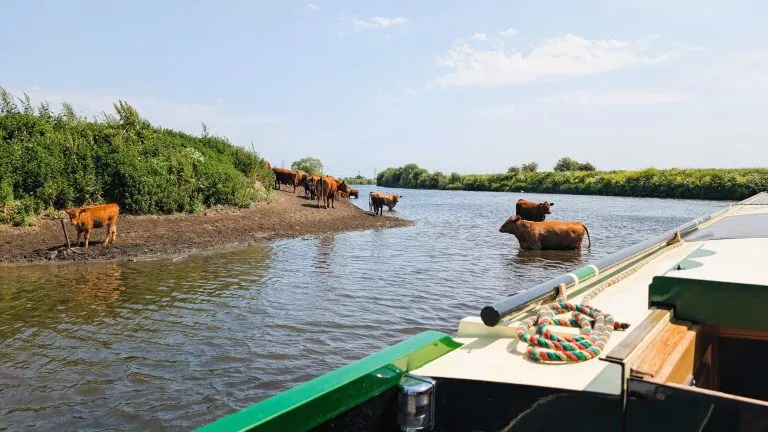
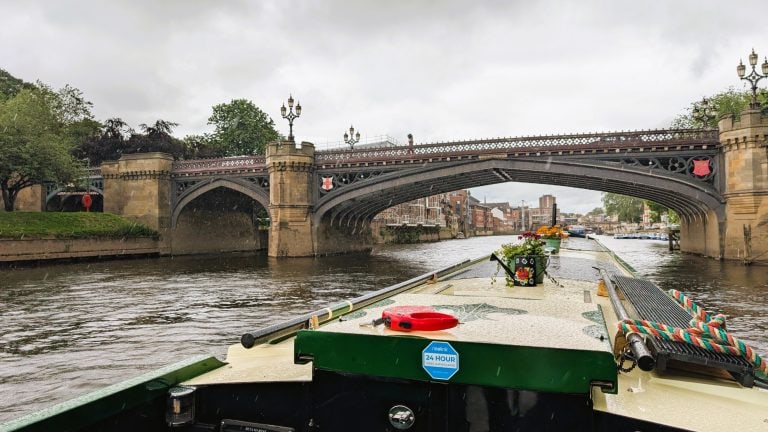
It has allowed us to see places we would never have visited when we lived in a house tied to one location. Each journey brings something different – quiet stretches of countryside where the world feels miles away, and the energy of towns and cities where the boat sits right in the heart of daily life.
We love the contrast. One day we might be moored in complete stillness, surrounded by birdsong and open sky. A few days later, we could be tied up in the middle of a city, watching life unfold from the stern deck.
It is this variety that makes the lifestyle so special.
Moving, Exploring and Staying Within the Spirit of the Rules
Living as continuous cruisers means embracing movement as part of everyday life. It is not just about meeting a legal requirement but about staying within the spirit of what the waterways are for – navigation and exploration.
The rhythm becomes familiar: travel, moor, explore, move on and discover somewhere new again.
And while the rules provide structure, they also create a framework that supports a shared experience on the waterways – one where everyone has the opportunity to enjoy the space.
A Different Way of Living
Continuous cruising is not simply about boats and licences. It is about choosing a different relationship with place and routine.
It requires flexibility, a willingness to move, and respect for the waterways and other boaters. In return, it offers something rare: the ability to wake up somewhere new, again and again, without ever needing to pack a suitcase or book a ticket.
For us, that is what makes it worthwhile.